Stuck in a Decision Spiral? Try This Instead
A little while ago I shared some thoughts on making decisions (Ready to Make Some Bad Decisions?). I promised that I’d also share the tools I use most often for making big decisions. Before I do that…
What kind of decision maker are you?
There are lots of overall decision-making strategies you can use, and while you probably use most of them (or combinations of them) at different times, it’s interesting to consider which way you usually lean.
So which of these sound most like you?
Impulsive – you go with the first option that comes your way and move on.
Compliant – you pick the option that feels the most comfortable, popular, or pleasing to everyone involved.
Delegate – you pass the decision-making to someone you trust instead of deciding yourself.
Avoid – you either avoid or ignore the decision altogether to keep from feeling overwhelmed… or to dodge responsibility!
Balance – you carefully weigh all the factors, consider them, and make the best decision based on what you know at the time.
Impact – you focus your time, energy, and thought on the decisions that will have the biggest impact.
If you’re struggling to make a big decision - or if you struggle with making decisions in specific circumstances or areas of your life - I invite you to:
consider what strategy you’re currently using, and
try out a different strategy to see what happens.
A real-life example
Recently, I was coaching a beautiful human being on how to best use a rare few weeks of holiday. They wanted to spend some time clearing things on their to-do list - but which ones?
Their first idea was to do things which could only be done during the day, taking advantage of their time off (a balanced approach). I then invited them to consider which things would have the biggest impact on them and their family (an impact approach).
Neither of these is “right” or “wrong” - they simply frame the decision in a different way, helping you to find the best solution for you.
Two decision-making tools you probably already use (and how to make them better)
There are two classic decision-making tools that you almost certainly use. And they’re classics for a reason - they can be really useful.
But… they can also leave you stuck in analysis paralysis - you know, when you go round and round in your head, so caught up in weighing all the options that you can’t decide on anything.
With a few tweaks to the way you use them, you can stop that endless looping and come to a decision you can jump into with both feet.
Instead of using… a pros & cons list
Try using… decision wheels
We’ve all whipped out a sheet of blank paper, drawn a line down the middle, and started listing pros and cons. It can be useful to get your thoughts down on paper, and it can help make simple decisions a cinch.
But for more complex decisions, it just doesn’t quite hit the mark.
Have you ever written a pros and cons list, made a decision, and then started second-guessing yourself… because it just feels… wrong… but you can see it there in black and white… but what if…? (Repeat, forever… 🤯)
This happens because we tend to list a lot of practical, surface-level things - without really taking account of the deeper impact on our lives, or how we feel about any of it.
A real decision example
Let me show you how to tweak this tool using a real example sent in by Alex (not their real name), one of our community members. They wrote:
“I've got a big decision that I'm going back and forth on - whether to move closer to my family. Overall I have a good relationship with them, though there have been some issues in the past. We have great friends where we are now and our child is settled in school, so it would be hard to leave. But with a new baby it would be nice to be closer to family support, and I'm also thinking ahead about my parents' health and what support they might need in future.
I feel a bit in limbo at the minute - arranging nursery for next year for the baby but not sure whether we'll be here, and my older child is making good friends at school but might have to leave.”
Step 0: Give yourself some space
Don’t rush this process. Give yourself some physical and mental space. Take some slow, deep breaths before you start, and drop into your body.
I invite you to notice what you’re feeling, physically and emotionally, during this process*.
Step 1: Make a list of the important factors in this decision
Eight factors is a good target to aim for (it’s fine if you have more or less). Make sure you’re including everything that’s important to you - decisions don’t happen in a vacuum.
Your decision will be better if it takes account of all the most important things in your life (for example, you wouldn’t make a decision about moving away for a job without considering the impact on your partner and kids).
In Alex’s case, those factors might be something like:
Older child
Baby
Partner
Parents / family
Social life
Career
Finances
Environment / location
Note down a sentence or two about what each factor means to you. For example:
Parents / family – nice to have a closer relationship, with boundaries due to previous issues. Want to be able to support them as they get older.
or
Environment / location – want easy access to the countryside. A garden is non-negotiable. Crucial for my mental health.
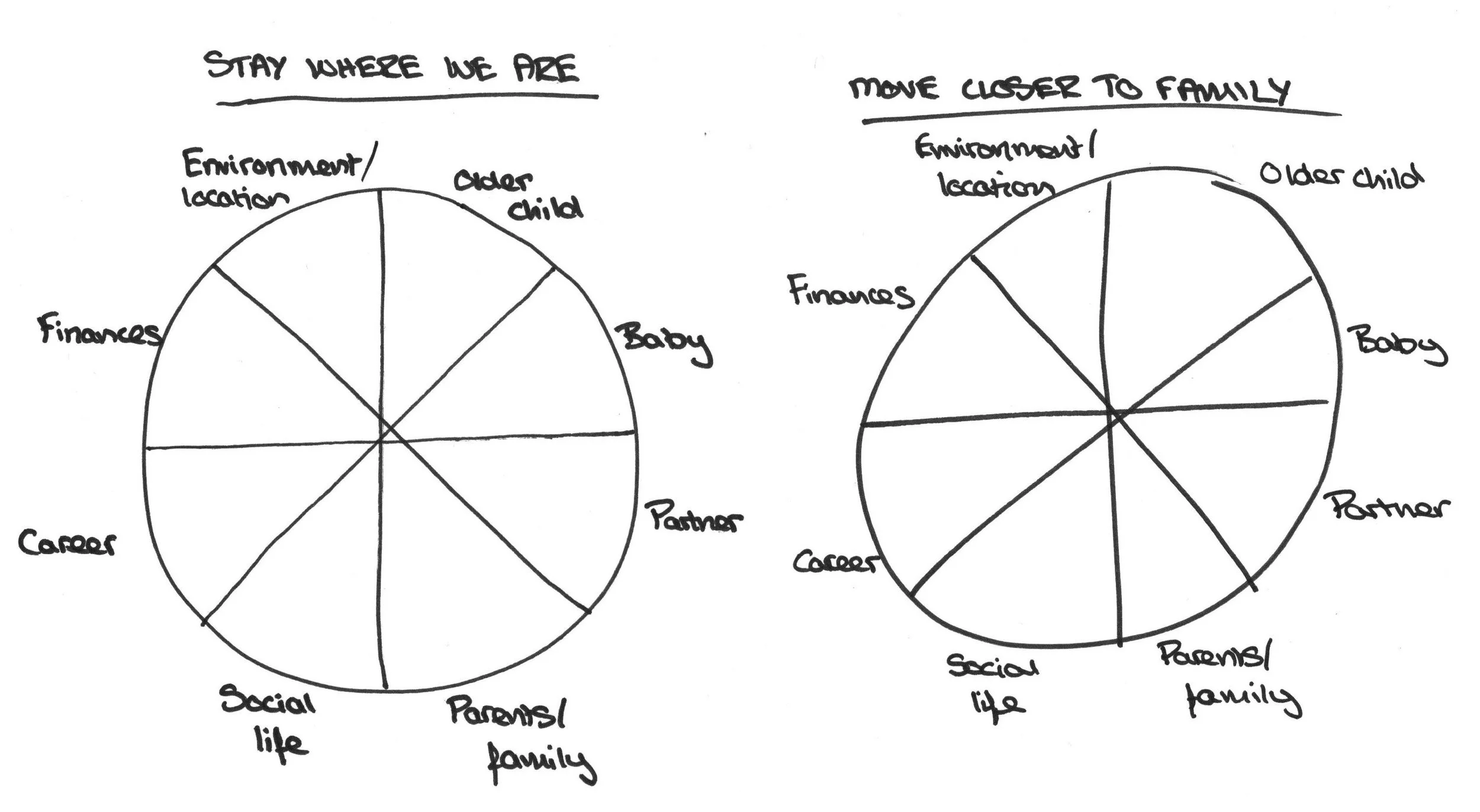
Step 2: Draw a decision wheel for each scenario you’re choosing between. Divide the wheels up according to the factors you’ve identified.
Alex will have two wheels - you might have more. Don’t overdo it though; determine the main potential options.
Alex’s wheels might look something like this:
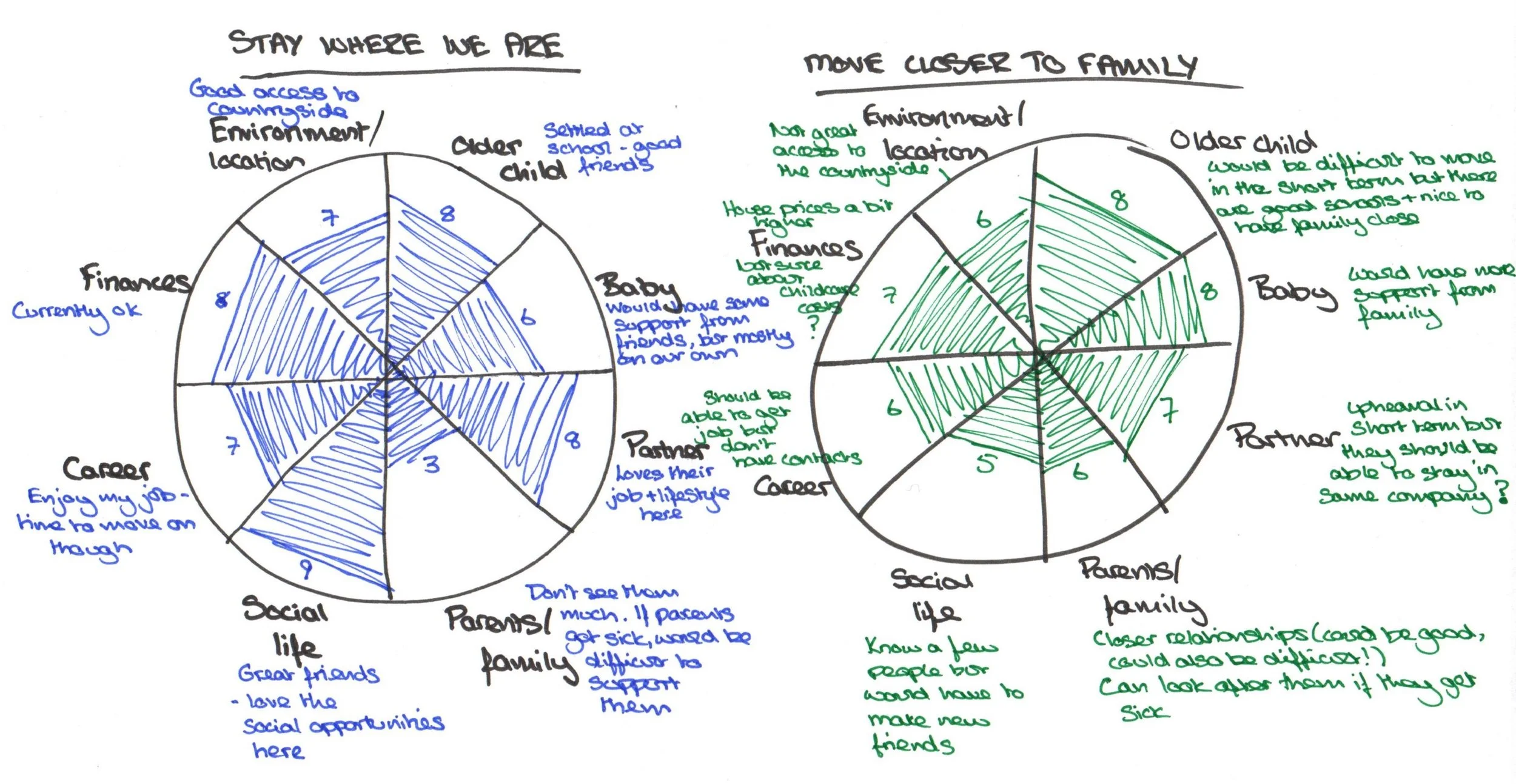
Step 3: In each wheel, score each factor out of ten
Don’t overthink it. Make some brief notes on your thought process as you go.
So for Alex, that might look like this:
Step 4: Take a step back - and notice how you feel
The point here is not to add up the scores and make a decision based on the highest total - that’s not how you experience your life.
You place more importance on some things than others.
Which factors are non-negotiable (mark them with an asterisk)?
Where can you compromise?
Now that you’re looking at the whole picture, is anything missing?
Do you need more information for some factors before being able to score them?
I then invite you to step away from binary thinking (e.g. “stay where we are” or “move closer to family”) and start asking questions like:
How could I have the best of both worlds?
How could I stay where I am and enjoy more support from my family?
How could I move and still stay closely connected with my friends?
Most importantly, tap into how you feel*. Ask yourself:
What emotions or physical sensations came up during this process?
If I had to decide right now, what would I choose?
What is my gut or intuition telling me?
Decision wheels don’t make the decision for you (soz!). They’re a tool to help you reflect at the level of values and impact - and to notice how you feel about the whole.
They’re also a place to go from. You might need more information. You might share your wheels with someone else, or ask them to do their own.
For Alex, this could mean their partner (and possibly even their older child, depending on age) doing the exercise too - which might surface some really interesting differences in priorities, thoughts, and feelings.
Instead of… asking others what you should do
Try… asking your body what you should do
When you’re stuck in analysis paralysis, it’s very tempting to start polling the people around you.
“What would you do if you were me? Just tell me what to do!”
I don’t know if you’ve noticed, but this rarely works. For a start, if you ask five different people, you’ll get five different answers - and probably some brand-new things to worry about that you hadn’t even considered 🤣
“This life is mine alone. So I have stopped asking people for directions to places they’ve never been. There is no map. We are all pioneers.”
I love this quote, and I agree that - no matter how much we might wish it - other people can’t make our decisions for us.
That said, I do think bouncing ideas off other people can help you notice how you feel about them.
My son used to ask me to choose which activity to do, or which film to watch. Nine times out of ten, when I chose something, he’d pause… think… and then choose the opposite!
It was only by me making the choice for him that he realised what he actually wanted. (Either that, or he reached his teens early 🤣.)
So rather than polling people in the hope that someone will take this wretched decision off your hands…
Use other people as a way to try ideas on for size. To gain perspectives you might not have considered.
Approach this with intention. Choose people who share similar values, who are open-minded and creative, and who lift you up.
And as always - see Step 0 above. Give yourself space, and notice how you feel physically and emotionally as you explore the ideas together*.
That’s it.
If you’re sitting with a decision right now, I hope this gives you something supportive - and a little less spin - to work with.
Love,
Mia
*If you struggle to feel into your body or emotions during these exercises, that’s very common. If you’d like, get in touch and I’ll share a simple exercise that helps build this skill.
If you’d like more reflections like this, I share them in my weekly e-letter - little love letters with stories, questions to sit with, and gentle reminders to step off the hamster wheel. You can join below👇 .